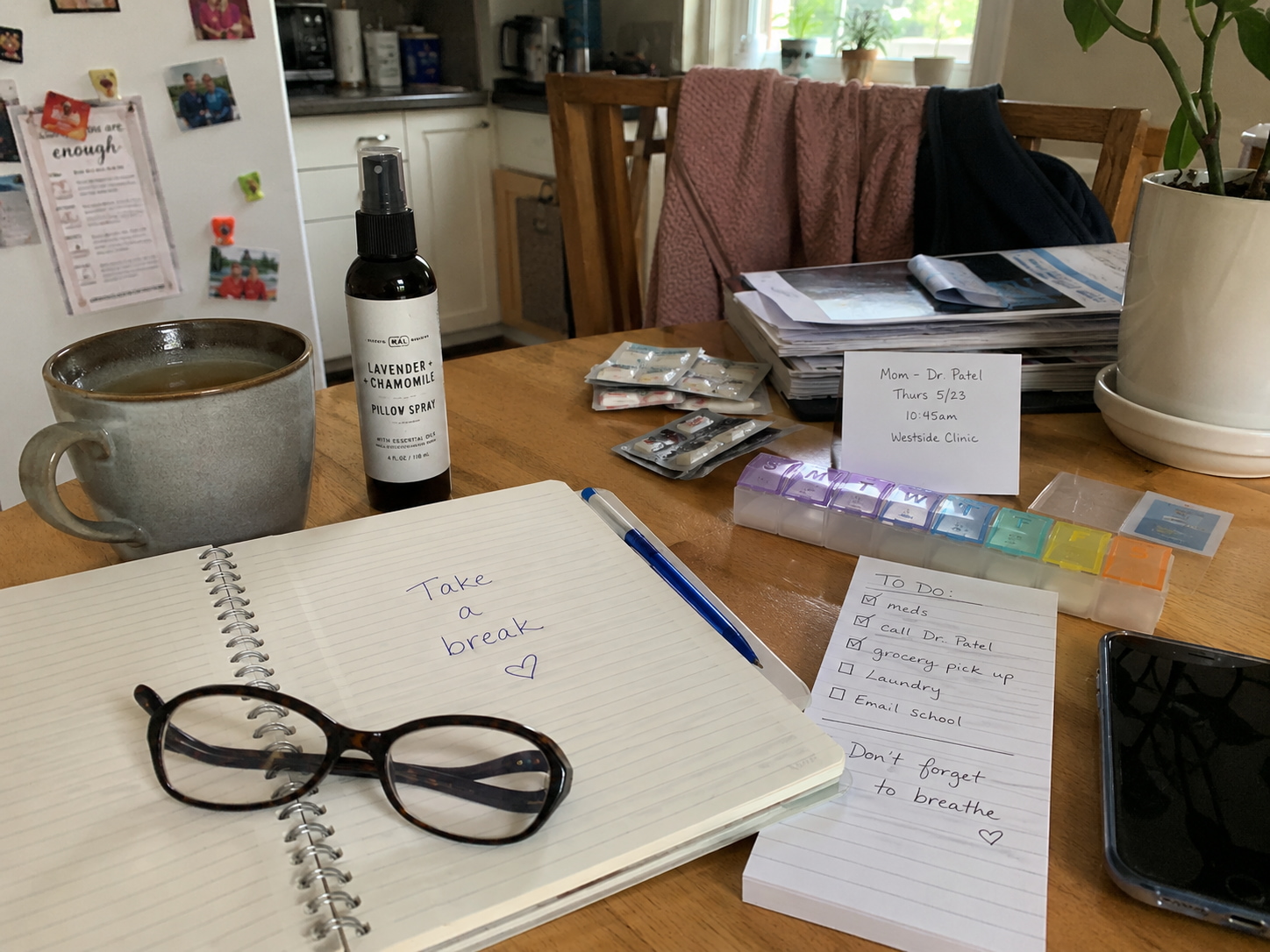

Grief isn’t just about death. There are the big, obvious griefs – what I call the “big G’s” – when somebody dies, when there’s a disaster, when a marriage ends, when a serious illness changes your life. These are the griefs we expect, the ones everyone can see.
But there are also the “little g’s,” which can be just as important to acknowledge. We often overlook the little griefs because they feel too small to discuss. But they still take up space in our hearts.
Parents go through little bits of grief when their children leave home – each one, each time. And then it suddenly ends up being a big bit of grief, because you’re an empty nester. Or you get a divorce, and even if it was your decision, you still grieve the loss of the life you had, the family that was there. You change jobs, and even if it’s a good move, you still grieve the connections, the people, the routines you’ve left behind. Even when your parents move from your childhood home, and you may not have lived there for years, there’s still grief in letting go of what that home represented.
The little g’s can build up quietly. I’ve noticed they compound. There’s a little one, another little one, and another… until it becomes a big thing.
There’s no shame in grieving these smaller losses. They are part of life’s constant changes, and they matter, too.
I remember someone describing Grief and Loss as the brain rewiring itself to experience the person, situation, place, etc., in a different way. It has to stop looking for it in a physical form, but as a memory, which takes time.
We All Grieve Differently
And all of these things need validating. They’re important. There’s nothing wrong with… well, I say “admitting”, but really it’s just about acknowledging and validating what you’re feeling.
We all grieve differently and for different amounts of time. It’s really, really important that we don’t judge people based on how they grieve or how long they grieve.
I know when my mother died, my sister and I grieved in very, very different ways. She became more hesitant and unsure of what to do, while I coped by becoming very organised – “do it this way.” We sometimes rubbed each other the wrong way because our managing methods were so different. But I couldn’t cope unless I became very structured about what was going on. That was my way of dealing with it.
I know when my mother died and indeed my father, my sister, and I reacted in very different ways, in some instances one extreme to the other, and this caused us to rub each other up the wrong way, and indeed fall out. At the time, because I was in the middle of the situation and could not see what was happening from the outside, I just thought she was being difficult, and she was being difficult to me. It is a really good example of how we can ALL experience situations in a very different way.
Not just grief, but trauma too.
And actually, that’s fine. We all need to deal with it differently.
When my father died, I completely went to pieces. I couldn’t make a decision for love or money. I really lost it, my sister seemed, on the other hand, to be the opposite (so you see it isn’t always the same reaction), and it went on like that for quite a long time, and that’s okay too.
Grief is like rolling hills. You will have times of great sadness, and then something will happen. You’ll have a really fun memory and you’ll go, “Oh, do you remember that?” and feel lightness and joy.
So, the highs and the lows aren’t necessarily… forgetting. It’s still part of the process; we can have good times without feeling guilty.
But I think part of the process is the fear that, if I don’t have that sadness, if I feel that joy, does that mean I’m forgetting them? No, because when we remember the good times, we remember that person, place, and situation.
Within that moment of losing something or someone, you might go out with friends, and somebody makes you laugh, or something amusing happens. Perhaps there’s an anecdote about the person where everybody was laughing before, and you laugh again. And then you think, “Oh my lord, do I feel guilty about laughing, having fun, and enjoying myself?” And actually, that’s really healthy. And it’s good.
And no, you don’t forget them. You don’t forget. Because as long as you remember their name, and you remember events and things that happened in and around whatever it is you’re grieving, they will always be with you. You remember with your heart and your head. You don’t need the physical presence in your life to remember them.
Why We Must Validate All Grief
Even when something was partly your choice, or you feel you “shouldn’t” be upset, the grief remains. That disappointment is still there.
People often feel guilty, especially if it was partly their choice, but that doesn’t mean there’s no loss.
Some grief is subconscious. It sits there, quietly, and builds up. And the little ones actually just compound, because there’s a little one, and another, until it becomes a big thing.
How to Gently Process Grief
You’ve got to walk through it.
You do have to because you have to acknowledge all the feelings, the good and bad, that go with that feeling of grief, whether they’re small or big.
It’s like children and temper tantrums or other big emotions. For example, when you take something away from a child they really want, they can have a tantrum. It’s a form of grief. The child can be really hacked off with you for stopping them from having, doing, or being. That’s a little g; they’re having a temper tantrum to express their feelings.
One of the reasons children experience big emotions is that they lack the words to express their feelings.
Is Loss Inherent in Grief?
I think grief is to do with a change, a change of something that you had but don’t have any longer. If you’ve loved something, liked something, enjoyed or experienced something, like a book you really loved, and it ends, and it’s sad, and you cry, it’s a form of grief. You’re not losing anything tangible per se, but there’s an emotional loss at the end of it. You can lose your favourite pair of winter gloves, your favourite plant dies in the garden, your best t-shirt finally falls apart, and there is a pang of sadness and loss. It comes in so many different ways.
Depending on how big the thing was in the first place, that determines how big a G it is in your life. And how significant an impact it has, how you’re going to manage it, and what an ongoing effect it has on you.
Gentle Practices for Dealing with Grief: EFT, Tapping, Reiki
Unless someone comes to me saying, “My grandmother died,” or “I’ve just lost my dog,” there are usually quite a lot of emotions going on around that. And often, other emotions present more strongly: fear, anger, sadness, loss.
They might not immediately name it as grief. And that’s okay, we don’t have to call it grief. People will describe it differently, and I work with their vocabulary.
If someone is truly overwhelmed, I suggest doing a Reiki session instead of tapping. We might also do some silent tapping or something called Traffic Light Tapping, just using the RED, ORANGE, and GREEN as indicators of how you feel. Sometimes, asking, “How does that make you feel?” is too much.
And that’s okay. You can say, “Even though I don’t know, it’s fine. I know I’m feeling something.” It doesn’t matter if you can’t describe it, because your subconscious and unconscious mind know exactly what’s going on, even if you consciously can’t articulate it.
Your unconscious mind is there to protect you. If you’re not ready to deal with something, your brain shuts it down to keep you safe.
For the smaller, everyday little g’s, I always teach people finger tapping – it’s quick and easy. You can do it in your pocket, behind your back, under a table, on the phone… anywhere. And you just breathe while you do it. With this method, you can help yourself in the moment and focus on what is going on in the here and now.
Then, when you are in a safe space, you can use the whole setup…
The setup is always: “Even though…” Then you describe what you’re feeling (e.g. cross, angry, upset, irritated), whatever it is. If you feel a lump in your throat, a weight in your chest, or like it’s hard to breathe, make sure to include that in your words.
You must clear the negative before you can bring in anything positive.
When I introduce tapping, I only talk about clearing the negative stuff. If you go to the positive too soon, it won’t last. You haven’t cleared the old emotion.
It’s like draining the bath of cold water before you refill it with hot water. If you pour in one kettle of hot water at a time, the bath stays cold for a long time, but once you drain out the cold water completely, you can fill it with warm water right away.
One good way to always have good memories close to hand, even when things look bleak, is to practice a simple technique even now, and it will hold with you forever.
It goes like this…
Think of something that really gives you a good feeling – perhaps a place, a person, a smell, an event, anything. Personally, I have the most divine-smelling rose in my garden, and that is my go-to favourite when things feel sad, bad, or just not good.
While you think about it, pinch your thumb and one other finger together hard enough to make an impression. Hold it like that so that you are sure that if you stopped and pinched those fingers together again, that memory would come to mind.
It might take a few goes to really embed it, that’s okay.
Do this with as many GOOD THOUGHTS as possible, so that you build us a bank of reserve good feelings for days/times/moments when things aren’t quite the way you’d like them.
We Grieve in Our Way
I think it’s essential to remind ourselves that we all grieve differently. We must allow others to experience it differently from us.
And to take as long as it takes.
Just because I grieve one way doesn’t mean everyone else will. And it’s okay to have happy times while you’re grieving.
Because life is a roller coaster.
Even when you’re grieving.
If you find yourself in a situation that is overwhelming, no matter what, I am there to help and support you, please reach out. Don’t feel as though you have to struggle on your own.
If you’d like to explore grief in a supportive setting, I’m running a gentle 2-hour online workshop on 6th and 8th September.
Find out more here →